Lettre N°19 : Affaire FTX, accumulation de BTC par les petits porteurs, pic d’inflation aux États-Unis.
 Écrit par Tristan Goutte
Écrit par Tristan Goutte
Écrit par Tristan Goutte
Bonjour à tous,
L’objectif de cette lettre est de vous informer sur la situation actuelle du marché des crypto-actifs, mais aussi des actualités récentes dans ce domaine. Cette lettre n’est pas un conseil en investissement, mais seulement un partage de mon point de vue personnel.
FTX traverse actuellement une crise sans précédent. Les fonds des utilisateurs de la plateforme de Sam Bankman-Fried sont toujours bloqués. Suivez l’évolution de la situation de FTX en temps réel.
Pour résumer en quelques lignes : une fraude a eu lieu de la part de Sam Bankman-Fried, le fondateur et CEO de la plateforme d’échange FTX et de la société de trading Alameda Research.
La plateforme FTX aurait utilisé les fonds déposés par ses clients pour renflouer les pertes d’Alameda Research et pour réaliser son activité de trading. De plus, la plupart des actifs et des collatéraux de prêt de la société étaient des FTT, le jeton natif de la plateforme.
Lorsque des rumeurs d’insolvabilités ont circulé, les clients de FTX ont commencé à retirer leurs fonds en grande quantité. Il s’est ensuivi un blocage des retraits : FTX ne pouvait pas les honorer puisqu’elle ne détenait pas les actifs de ses clients avec un ratio de 1 pour 1.
Une fois que le marché a été saisi par la panique, le jeton FTT s’est effondré, réduisant drastiquement tous les actifs de la plateforme de FTX et d’Alameda Research. Le marché des crypto-actifs a ensuite fortement baissé et il s’est ensuivi une importante vague de retraits des actifs des plateformes d’échange. Cette période est un stress test pour toutes les plateformes d’échanges, surtout les plus faibles financièrement.
Le marché des crypto-actifs subit actuellement une « purge » des acteurs faibles et/ou surendettés, suite à cet événement de fraude d’un acteur centralisé. Malgré les difficultés pour les acteurs et pour les investisseurs, les « purges » sont saines et nécessaires pour la continuité du développement de cette récente classe d’actifs.
Ce qu’il faut retenir :
–> Les propositions de valeurs des blockchains (Bitcoin, Ethereum et d’autres) restent tout aussi solides et n’ont en aucun cas échoué.
–> Le secteur de la DeFi (finance décentralisée) continue à fonctionner parfaitement.
–> La cause de cet événement est la fraude qui reste à ma connaissance une propriété humaine.
–> Les plateformes d’échanges crypto ne devraient pas posséder de réserve fractionnaire. Les réserves des dépôts des clients devraient être de 1 pour 1.
–> Les plateformes d’échanges ne devraient pas utiliser leurs propres jetons comme des actifs dans leurs sociétés.
–
Note complémentaire : aucun de nos clients n’a subi de pertes sur le jeton FTT ou sur la plateforme d’échange FTX. Nous travaillons uniquement avec la plateforme la plus solide du marché : Binance.
–
71 milliards de dollars de cryptomonnaies – Les folles réserves de Binance. Suite à cet événement, un élan de transparence a été lancé par le fondateur de la plateforme Binance. La plateforme a publié ses adresses de portefeuille, et l’on apprend qu’elle dispose de réserves conséquentes, à hauteur de 71 milliards de dollars. Par la suite, de nombreuses plateformes ont publié leurs réserves. Binance est de loin l’acteur qui possède le plus de réserve.
–
Shell et Bitcoin : le géant du pétrole se lance dans le minage. La société pétrolière Shell plonge progressivement dans le minage de Bitcoin (BTC). La compagnie propose des produits qui permettent aux entreprises du secteur d’améliorer leur rentabilité et le bilan écologique.
–
DeFi : JP Morgan a réalisé sa première transaction sur Aave. Dans le cadre de projets expérimentaux avec la banque centrale de Singapour, JP Morgan a effectué des transactions sur le protocole de finance décentralisée (DeFi) Aave Arc pour la première fois. Pour la banque centrale de Singapour, le regard est donc résolument tourné vers les expérimentations autour de la blockchain. Et pour cause, la MAS (Autorité monétaire de Singapour) a mené cette opération avec JP Morgan dans le cadre du programme « Project Guardian ». Ce vaste plan se compose d’un ensemble de projets visant à tester les propositions de valeur apportées par les innovations de la DeFi, afin d’en considérer leur utilisation à plus long terme.
–
Google lance un service de cloud dédié aux nœuds Ethereum. On apprend cette semaine que le géant de la Tech propose désormais un « Blockchain Node Engine », qui permet d’héberger des nœuds Ethereum. Concrètement, cela veut dire que le processus de synchronisation sera grandement accéléré par le service de Google. Un nouveau nœud pourra être déployé en une seule opération. Pour l’instant, le service se concentre sur la blockchain Ethereum, mais il sera ouvert à d’autres réseaux à l’avenir. Petit à petit et discrètement, les géants du web 2 opèrent leurs transitions vers le web 3, ce qui est un bon signe de l’adoption qui s’opère.
–
Mastercard accueille 7 sociétés blockchain et Web3 dans son incubateur de startups. Le géant du paiement Mastercard s’implique toujours plus dans l’écosystème blockchain, en accompagnant sept startups Web3 dans une nouvelle promotion de son incubateur. L’intérêt de Mastercard pour la blockchain n’est plus à démontrer et les nouveaux bénéficiaires de son programme d’incubation Start Path en sont un exemple supplémentaire.
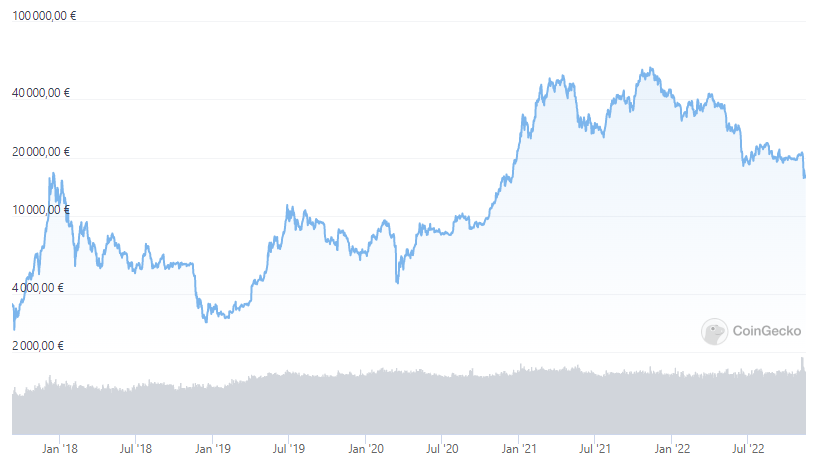
Le cours du Bitcoin à l’heure où j’écris ces lignes est de 17 000 $ (le 15/11/22)
La faillite de la plateforme d’échange FTX rappelle fortement l’échec de Mt Gox en 2013. Cette plateforme possédait 80 % du marché des échangeurs centralisés, ce fut une période difficile pour le marché et pour les investisseurs laissés.
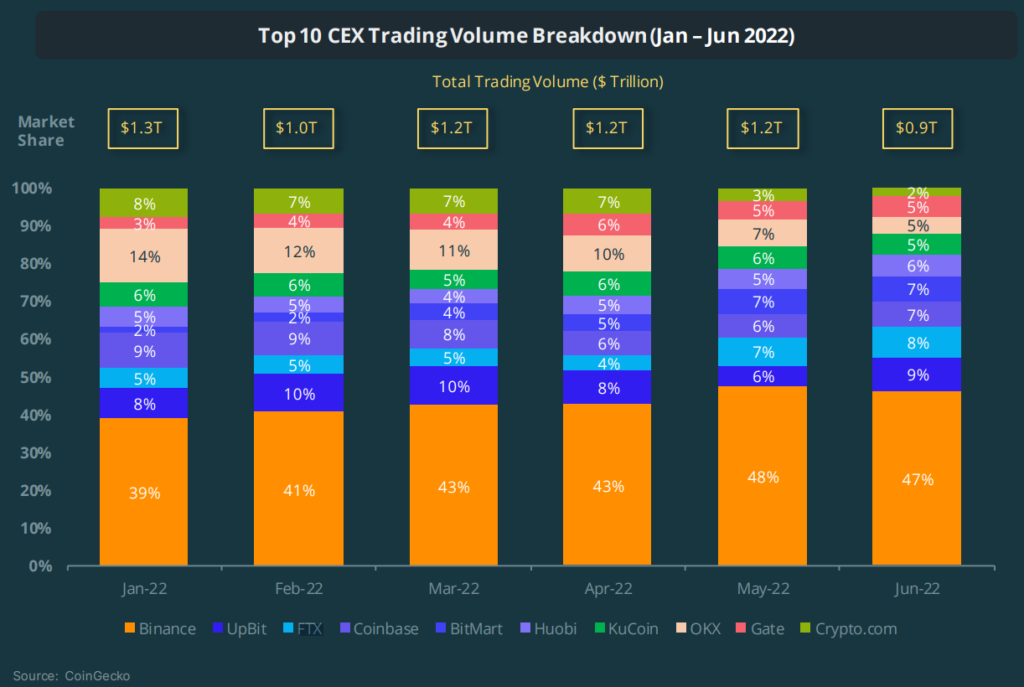
Cependant, FTX possédait 8 % du marché des échangeurs centralisés en termes de volume (voir ci-dessous), ce qui est moins grave que Mt Gox. En revanche, il y aura des retombées dans les semaines à venir : d’autres entreprises feront probablement faillite et une réaction en chaîne peut se produire. C’est un coup dur pour l’écosystème qui va perdre en bonne réputation, ce qui va ralentir provisoirement la vitesse d’adoption. Il y aura aussi probablement des retombées en termes de durcissement de la réglementation.
Cet événement est regrettable et a brisé l’élan que le marché crypto était en train de construire. L’inflation aux États-Unis a baissé et le dollar a stoppé net sa hausse : c’était un cocktail parfait pour sortir par le haut de ce long plateau que le marché a construit ces derniers mois. Suite à la panique des marchés, ce fut une sortie par le bas du plateau et la potentielle hausse est reportée à plus tard en attendant que les conséquences de la faillite de FTX soient complètement connues et absorbées par le marché, ce qui prendra du temps, probablement quelques mois.
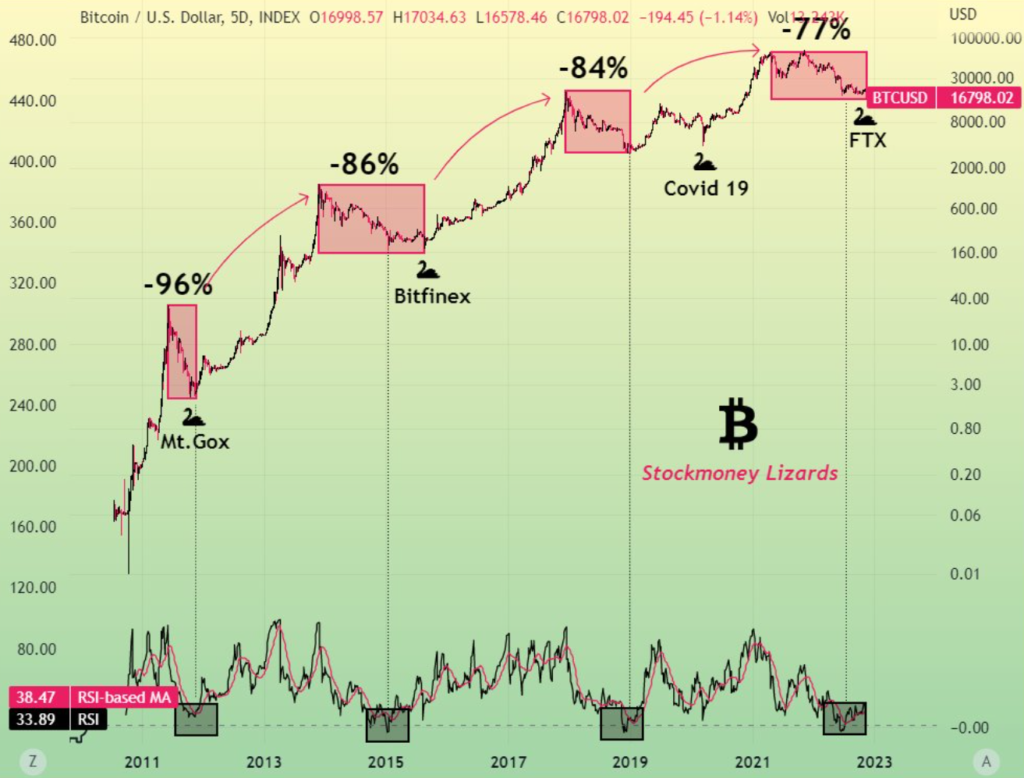
Comme nous pouvons le voir ci-dessous, la plupart des fins de cycle font ressortir des « cadavres du placard » : Mt. Gox, Bitfinex, FTX. Quand le marché est sous tension et manque de liquidité : l’histoire se répète.
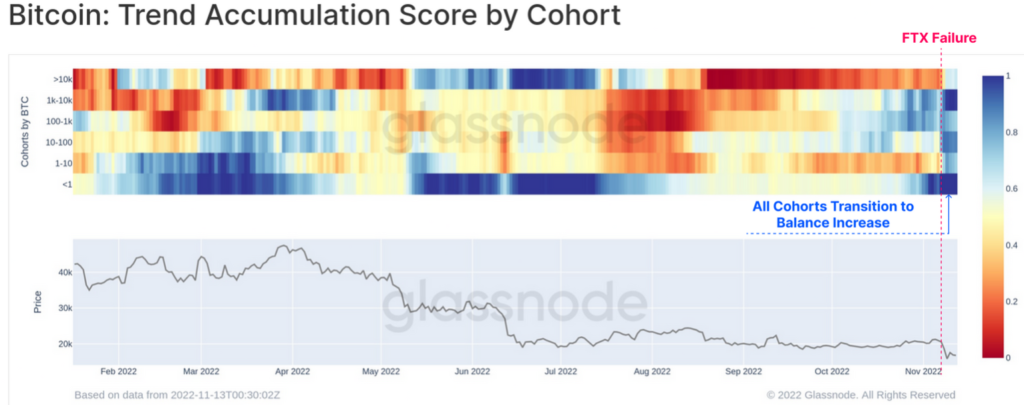
Du côté des bonnes nouvelles, toutes les catégories d’investisseurs ont accumulé des Bitcoins suite à la faillite de FTX. Voici ci-dessous un graphique qui répartit les investisseurs par catégorie (ceux qui possèdent <1 BTC; entre 1-10 BTC; 10-100; 100-1k; 1k-10k et >10 k). Nous remarquons facilement (en bleu) tout à droite, le score d’accumulation positif pour chaque cohorte d’investisseurs.
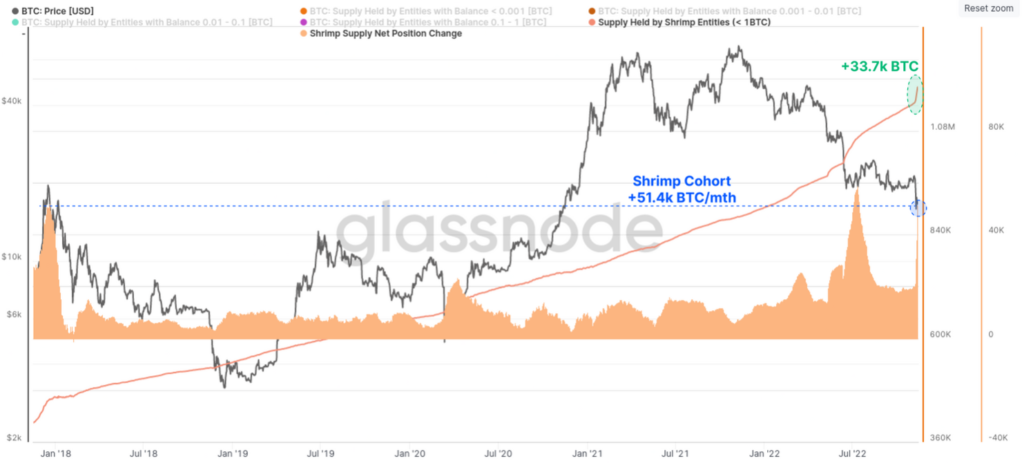
La variable qui est importante et qui représente l’adoption du réseau est la cohorte des petites entités qui possèdent moins de 1 bitcoin. Cette cohorte appelée crevettes (<1BTC) a ajouté 33,7k BTC cette semaine, ce qui a entraîné une augmentation de +51,4k BTC sur 30 jours. Ce niveau d’afflux de solde est le deuxième plus important de l’histoire. Comme nous pouvons le voir ci-dessous, dans le cercle vert, les petits investisseurs ont fortement acheté pendant cette baisse. C’est le signe de la bonne santé du réseau et de l’adoption qui continue ainsi que de la confiance croissante, même si les cours baissent.
–
L’inflation aux États-Unis est en baisse ce mois-ci, de 8,2 % à 7,7 %. L’inflation « sous-jacente », (déduite de l’alimentation et de l’énergie) est en baisse aussi, de 6,6% à 6,3%. C’est une bonne nouvelle pour les marchés risqués (actions, crypto), car il est probable que les rehaussements de taux de la part de la FED ralentissent, ce qui par la même occasion a sifflé la fin (pour l’instant) de la hausse fulgurante du dollar contre d’autres paniers de devises. Ceci était prévisible en vue du rythme insoutenable de la hausse du dollar. En revanche, la faillite de FTX a fait du marché crypto le « dindon de la farce », et celui-ci n’a pas pu profiter d’une hausse suite à l’affaiblissement du dollar.
En Europe, c’est tout autre chose, puisque nous ne sommes pas indépendants en termes d’énergie et que nous avons fait des erreurs stratégiques importantes. L’inflation, dont nous parlions déjà, il y a presque plus d’un an, est portée par 4 importants facteurs qui sont tous imbriqués les uns dans les autres :
Ces différents facteurs nous donnent un résultat qui fait froid dans le dos pour les habitants de l’Europe :
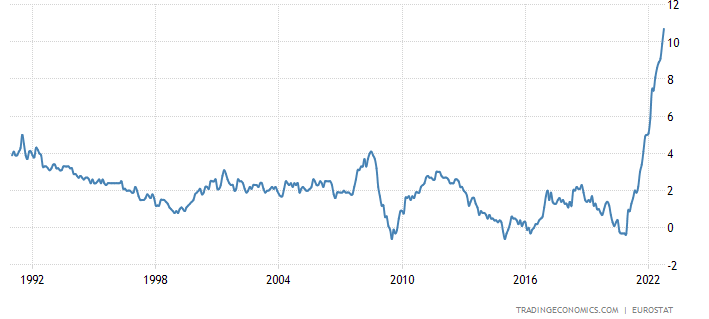
Malheureusement, le pic n’est pas encore atteint. L’inflation en Europe sera durable.
Si vous avez des questions, des remarques ou si vous souhaitez en savoir plus sur notre service, n’hésitez pas à nous contacter : crypto.assets.manage@gmail.com
— Avertissement —
Ceci n’est pas un conseil en investissement, personne ne peut prédire l’avenir.
Vous êtes seul responsable de vos décisions d’investissement.
Nous ne sommes pas responsables des pertes suite à une décision prise sur la base des informations de cette lettre.
Nous ne divulgons pas vos informations personnelles Voir notre Politique de vie privée pour plus d'informations.