L’objectif de cette lettre est de vous informer sur la situation actuelle du marché des crypto-actifs mais aussi des actualités récentes dans ce domaine. Cette lettre n’est pas un conseil en investissement, mais seulement un partage de mon point de vue personnel.
Actualités
Suivre la croisade en direct de la SEC contre les cryptomonnaies en temps réel. La Securities and Exchange Commission (SEC) des États-Unis a confirmé son intention de déclarer la guerre à l’écosystème crypto sur le sol des États-Unis. Suivez l’évolution de la situation opposant la SEC à l’écosystème crypto aux États-Unis sur le lien ci-dessus.
–
Le républicain Warren Davidson dépose un projet de loi pour « virer Gary Gensler ». Iln’a pas mâché ses mots à l’encontre du président de la SEC : « Les marchés financiers américains doivent être protégés d’un président tyrannique, y compris l’actuel. C’est pourquoi je présente un projet de loi pour remédier à l’abus de pouvoir en cours et assurer une protection qui est dans le meilleur intérêt du marché pour les années à venir. Il est temps de procéder à une véritable réforme et de virer Gary Gensler en tant que président de la SEC. »
–
Vitalik Buterin présente 3 transitions à mener pour Ethereum. Dans son dernier article de blog, Vitalik Buterin a exposé 3 axes d’amélioration par lesquels Ethereum (ETH) devrait impérativement passer pour connaître une adoption du grand public. Si ces idées ne sont encore qu’au stade de réflexions, elles pourraient poser les bases du futur visage de la célèbre blockchain.
La plus grande banque du Japon s’apprête à lancer des stablecoins sur l’écosystème Ethereum. Des banques à la présence grandissante dans le Web3 ? Le groupe japonais MUFG s’est exprimé sur le lancement de sa plateforme de stablecoins, dont les actifs seront notamment déployés sur la blockchain Ethereum. C’est un pas de plus du secteur bancaire vers le Web3, consolidant ainsi les solutions et applications développées autour de la technologie blockchain
–
Polygon (MATIC) : 100 millions de dollars d’obligations tokénisées par Defactor Labs. S’il y a bien un avenir prometteur, c’est la tokénisation d’actifs réels sur la blockchain. La startup Defactor Labs a annoncé la tokénisation de 100 millions de dollars d’obligations sur la blockchain Polygon (MATIC). Cela permettra de rendre les investissements en obligations plus transparents, rapides, accessibles et moins couteux.
–
Près de 10 milliards de dollars d’ETH détruits : qui participe le plus au burn sur Ethereum ? Avec près de 3,37 millions d’ETH brûlés pour 9,8 milliards de dollars, c’est l’occasion de faire le point sur les fonctions de burn d’Ethereum. Qui contribue le plus à la réduction de l’émission sur le réseau ? Depuis l’entrée en vigueur de l’EIP-1559 sur Ethereum en août 2021, le nombre d’ETH brûlés ne cesse de croître. Cette tendance a été accentuée par le succès de The Merge, ce qui tend même parfois à rendre l’actif déflationniste, en fonction de l’activité présente sur le réseau.
Analyse Fondamentale
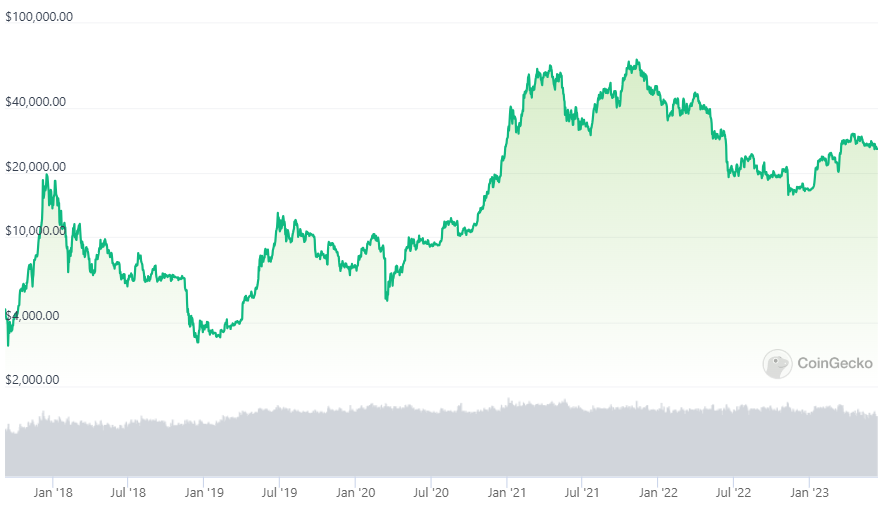
Le cours du Bitcoin depuis les cinq dernières années en euros et en échelle logarithmique. Source : https://www.coingecko.com/fr
Le cours du Bitcoin à l’heure où j’écris ces lignes est de 26 000$ (le 14/06/23).
L’Apathie du marché :
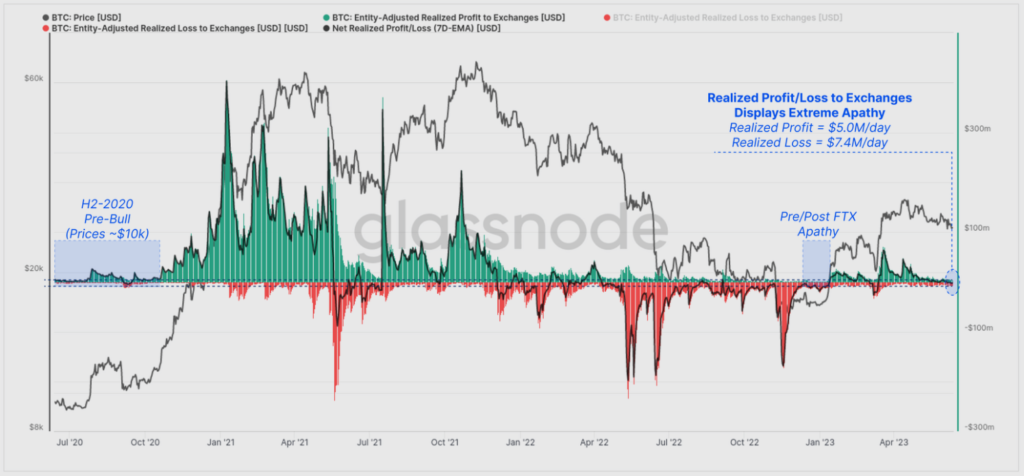
Nous pouvons qualifier le marché actuel en état d’apathie : c’est un état d’indifférence ou d’insensibilité. En effet, sur ce graphique de Glassnode ci-dessous, on peut remarquer que toutes les pièces de Bitcoin envoyées actuellement aux plateformes d’échanges ont été acquises à un prix très proche de la fourchette actuelle (18 k € et 32 k €) et ont été achetées très récemment. Elles sont donc probablement détenues par des investisseurs de la catégorie des STH (Short terme Holder = détenteur à court terme).
Plus les courbes vertes et rouges sont proches de la moyenne (ligne horizontale), plus les investisseurs ne sont pas incités à vendre en raison de la proximité du prix actuel avec leur prix d’achat.
Profits et pertes réalisés des pièces de Bitcoin lors des envois vers les plateformes d’échanges Source : Glassnode
Le graphique ci-dessus témoigne d’un degré de confiance relativement fort des investisseurs par rapport aux sujets des attaques réglementaires en cours aux USA, mais aussi de l’apathie des investisseurs, c’est-à-dire de la non-incitation à vendre proche de leur prix d’achat.
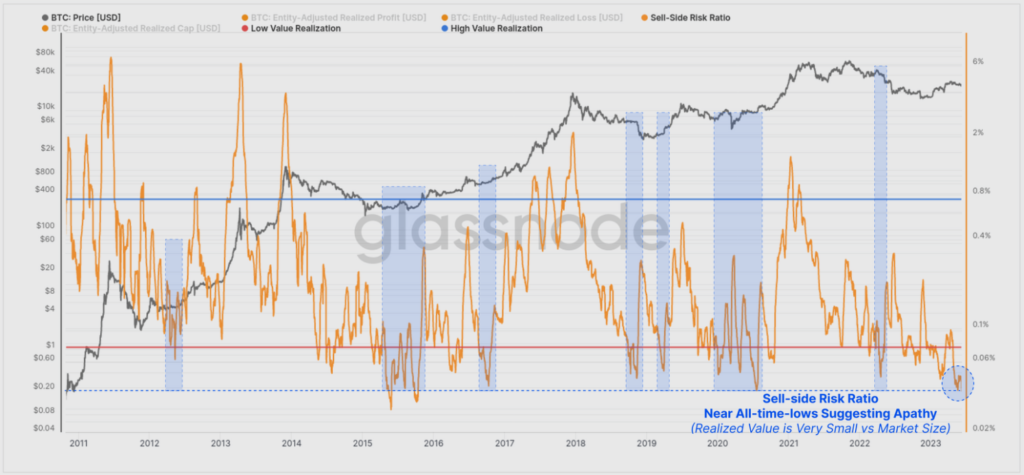
Grâce à ces niveaux de profit ou de perte (par rapport aux points d’achats des investisseurs récents), le ratio du risque de vente est tombé à des niveaux historiquement bas. Vous pouvez le voir sur le graphique ci-dessous qui compare le profit et la perte agrégée par le marché par rapport à la valeur de la capitalisation réalisée du marché.
La capitalisation réalisée du marché est une variation de la capitalisation boursière classique qui valorise chaque UTXO (transaction) en fonction du prix lors de son dernier déplacement. Cette capitalisation réalisée réduit l’impact des pièces perdues et dormantes depuis longtemps, et pondère les pièces en fonction de leur présence réelle dans l’économie d’une blockchain (Bitcoin pour notre exemple).
La valeur totale de ces profits et pertes est extrêmement faible par rapport à la capitalisation réalisée du Bitcoin (qui est de 391 milliards de dollars). Les faibles valeurs du ratio de risque de vente se sont historiquement produites pendant les périodes d’apathie accrues des investisseurs, généralement durant les longues périodes entre les cycles de marché du bitcoin.
Ratio profit et perte agrégés par rapport à la valeur de la capitalisation réalisée du marché Source : Glassnode
Nous pouvons aussi voir ci-dessous que le volume global des transferts se négocie à des creux cycliques. Cette semaine, nous avons vu un volume global des transferts relativement faible (à environ 2,85 milliards de dollars par jour). Pour autant, ce volume représentait un montant très élevé lors du cycle précédent, en 2020.
Volume global des transferts par jour Source : Glassnode
Pour résumer, le marché reste plat, inerte et s’ennuie dans l’attente du cycle suivant malgré l’environnement réglementaire aux États-Unis qui reste hostile. Les investisseurs de court terme ont probablement vendu dans la peur et la réaction presque inexistante des détenteurs à long terme suggère que de nombreux investisseurs n’ont pas été surpris par la nouvelle attaque de la SEC.
L’adoption globale des actifs numériques dans le monde :
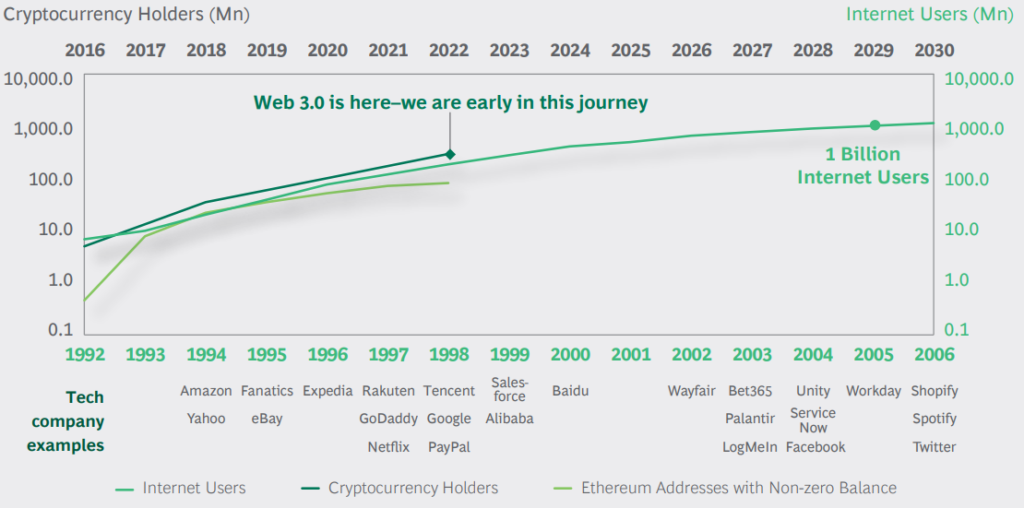
Comme nous pouvons le voir dans le graphique ci-dessous, l’adoption des actifs numériques dans le monde n’en est qu’à ces débuts. Comparé à l’adoption d’Internet, c’est comme si nous étions dans les années 1998 ou 1999. Nous avons encore 20 ans de développement et d’adoption qui nous attendent. Le paysage de l’écosystème peut encore radicalement changer.
Ce qui est intéressant à noter, c’est que nous nous sommes sur la même vitesse d’adoption que pour Internet, peut-être même légèrement plus. De nombreux projets peuvent encore apparaître dans les années à venir et dominer le marché dans 20 ans à l’instar de Google (YouTube), Facebook, Twitter, Netflix, Amazon etc…
Nombre de détenteurs d’actifs numériques dans le monde Source : Rapport de Boston Consulin Group, Bitget et Foresight Ventures
Il est pertinent de comparer l’adoption des actifs numériques avec celle d’Internet, car les cryptos sont une continuité d’Internet : c’est en quelque sorte une extension de ce que l’on peut faire avec Internet. Voici une phrase dans laquelle nous croyons :
« La Blockchain sera à la banque, au droit et à la comptabilité, ce qu’Internet a été aux médias, aux commerces et à la publicité. »
Vous pouvez aussi retrouver un Index du score de l’adoption des cryptos dans le monde avec un classement par pays sur le site de Chainalysis. Nous pouvons voir que la France se situe à la 32e position (en 2022).
Index du score de l’adoption des cryptos dans le monde Source : Chainalysis
572 000 000 000 $ ajoutés à la dette américaine en deux semaines :
Selon les derniers chiffres de FiscalData, au 15 juin, la dette nationale américaine s’élevait à 32,03 billions de dollars, soit une augmentation de 572 milliards de dollars par rapport au 1er juin (31,46 billions de dollars). La dette totale dépasse désormais le PIB combiné de la Chine, du Japon, de l’Allemagne et du Royaume-Uni.
Aux taux d’intérêt actuels, les États-Unis paient plus de 2 milliards de dollars par jour en paiements d’intérêts, et même si chaque ménage américain versait 1 000 dollars par mois pour rembourser la dette, il faudrait encore 20 ans pour qu’elle soit remboursée.
La dette des États-Unis s’élève actuellement à 31 000 milliards de dollars. Est-il plus probable qu’elle atteigne 50 000 milliards de dollars ou 25 000 milliards de dollars ? Il est plus probable d’atteindre 50 000 milliards de dollars que 25 000 milliards de dollars. La situation perdure donc.
Ray Dalio, le créateur du plus grand fonds spéculatif au monde, Bridgewater Associates, a également déclaré récemment que les États-Unis entraient dans ce qu’il appelle une « crise de la dette très classique de fin de grand cycle ».
C’est pour cette raison que nous pensons qu’à long terme (+20 ans), la valeur des dollars aura continué dans sa direction de perte de pouvoir d’achat, le phénomène se sera même probablement amplifié. Il n’y a que deux solutions envisageables pour nos économies occidentales : le remboursement de nos dettes par le travail et la production (vivre en-dessous de ces moyens pour rembourser) ou l’inflation qui détruira notre dette libellée dans une monnaie que l’on continuera « à imprimer » (continuer à vivre au-dessus de nos moyens).
Nous pensons que nos économies prennent la direction de la seconde option, ce qui signifiera de l’inflation à long terme et une baisse de la valeur de nos monnaies occidentales.
C’est le même constat pour l’Europe et la zone euro.
Notre service
Nous proposons un service de gestion sous mandat de portefeuilles spécialisés dans les actifs numériques. Nous réalisons un accompagnement humain complet dans cet univers en adaptant l’allocation de votre portefeuille à votre profil de risque et à votre situation.
Notre gestion clé-en-main vous permet de profiter de l’évolution de ce secteur sans vous soucier du choix des actifs numériques à mettre dans votre portefeuille, ni des recherches approfondies sur les jetons, ni de la volatilité, ni des arbitrages, etc… Vous avez seulement à lire vos rapports mensuels et à investir régulièrement avec un horizon long terme (4 ans et plus).
Nous ne faisons pas de trading algorithmique ou de trading journalier, nous investissons pour le long terme dans des projets que nous connaissons et que nous comprenons. Nous faisons des arbitrages mensuels dans les portefeuilles et étudions en profondeur les actifs (surtout leur tokenomics) que nous mettons en portefeuille.
Si vous avez des questions, des remarques ou si vous souhaitez en savoir plus sur notre service, n’hésitez pas à nous contacter sur cette adresse mail : tristan.g@crypto-assets-management.comou à prendre un RDV téléphonique avec nous via ce lien.
— Avertissement —
Ceci n’est pas un conseil en investissement, personne ne peut prédire l’avenir.
Vous êtes seul responsable de vos décisions d’investissement.
Nous ne sommes pas responsables des pertes suite à une décision prise sur la base des informations dans cette lettre.
Recevez nos lettres dans votre boîte mail
Nous ne divulgons pas vos informations personnelles
Voir notre Politique de vie privée pour plus d'informations.
 Écrit par Tristan Goutte