L’objectif de cette lettre est de vous informer sur la situation actuelle du marché des crypto-actifs mais aussi des actualités récentes dans ce domaine. Cette lettre n’est pas un conseil en investissement, mais seulement un partage de mon point de vue personnel.
Actualités
Crise bancaire : la moitié des banques américaines seraient potentiellement insolvables. La crise bancaire continue aux États-Unis, avec la moitié des banques américaines ayant épuisé leurs réserves de capitaux, selon une information de The Telegraph. Ainsi, des milliers de banques seraient potentiellement insolvables, dont une banque mondiale considérée comme systémique. A-t-on atteint le point de non retour ?
–
1 million d’adresses détiennent désormais plus de 1 Bitcoin (BTC). Le Bitcoin (BTC) continue de convaincre les investisseurs, qui lui accordent une place de plus en plus grande dans leurs portefeuilles. En ce mois de mai 2023, un nouveau record a été franchi : un million d’adresses détiennent désormais plus de 1 BTC complet. Voyons ensemble ce que cela signifie.
–
TRIBUNE – Web3 : ne pénalisons ni la croissance de nos entreprises ni l’attractivité de la France. Alors que la France et la place de Paris se hissent en haut du classement des lieux les plus prisés par l’écosystème du Web3 autour du globe, la proposition de loi voté par l’Assemblée nationale fin mars pourrait pénaliser nos ambitions dans ce secteur plein d’opportunités. Que risque l’industrie alors que 10% des Français détiennent des actifs numériques dans leurs portefeuilles d’investissement ?
–
Les clients de PayPal ont investi 943 millions de dollars en cryptomonnaies. Dans un document déposé auprès de la SEC, nous apprenons que PayPal compte près d’un milliard de dollars ayant été investis dans les cryptomonnaies par ses clients. Comment évolue le géant des paiements vis-à-vis de cet aspect-là de son activité ?
–
Le géant du paiement Stripe étend son offre fiat-to-crypto pour conquérir le Web3. Stripe, le géant des solutions de paiement aux États-Unis, a lancé sa solution fiat-to-crypto on-ramp pour permettre aux entreprises du Web3 de fournir une option facile pour que leurs clients puissent acheter des cryptomonnaies. Cette solution vise à accélérer l’adoption du Web3 et a déjà été adoptée par des entreprises telles que le réseau social Lens, le protocole DeFi 1inch et le navigateur Brave.
–
Tether, un « géant château de cartes » ? Son dernier rapport divise. Tether, l’émetteur de l’USDT, a publié son premier rapport trimestriel pour 2023, révélant un excès de réserves record de 2,44 milliards de dollars. La société a également partagé la répartition de ses réserves en cash, dépôts à court terme, Bitcoin (BTC) et or. Tether maintient sa position dominante sur le marché des stablecoins, avec une capitalisation boursière de 82,87 milliards de dollars, mais certains conservent des doutes sur sa transparence.
–
Blockchain : BNP Paribas, Goldman Sachs et Microsoft participent au lancement du réseau Canton. Dernièrement, plusieurs grands groupes technologiques et financiers ont participé au lancement de la blockchain Canton. Destiné à rendre interopérables les systèmes financiers entre eux, ce réseau témoigne de l’intérêt des institutionnels à une période où peu d’entre eux estiment une reprise haussière du marché des cryptomonnaies.
Analyse Fondamentale
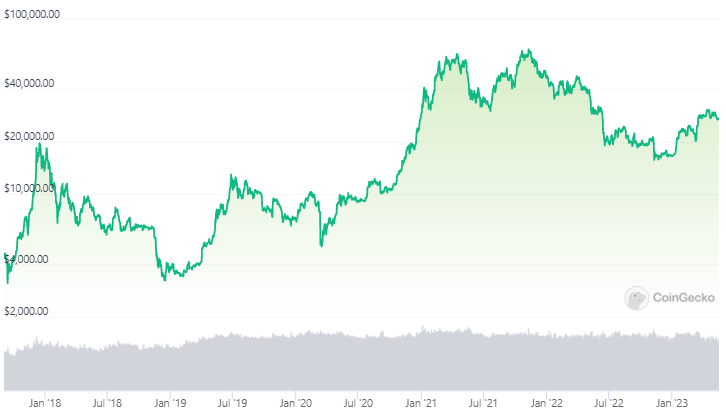
Le cours du Bitcoin depuis les cinq dernières années en euros et en échelle logarithmique. Source : https://www.coingecko.com/fr
Le cours du Bitcoin à l’heure où j’écris ces lignes est de 26 780$ (le 17/05/23).
La ruée vers le staking d’Ethereum continue :
La dernière mise à jour d’Ethereum qui a permis la double mise à niveau, nommée « Shapella et Shanghai », a été effectuée avec succès au mois d’avril. Lors de notre dernière lettre, nous vous présentions l’augmentation du nombre d’Ether déposé en staking.
Pour rappeler ce qu’est le staking : c’est le fait de déposer des jetons (Ethers pour la blockchain Ethereum) en collatéral dans le but de sécuriser la blockchain (Ethereum) et de recevoir en contrepartie une fraction des frais générés par le réseau (frais qui sont payés par les utilisateurs du réseau Ethereum). Ceci est valable uniquement pour les blockchains qui ont un mécanisme de consensus basé sur le Proof of Stake.
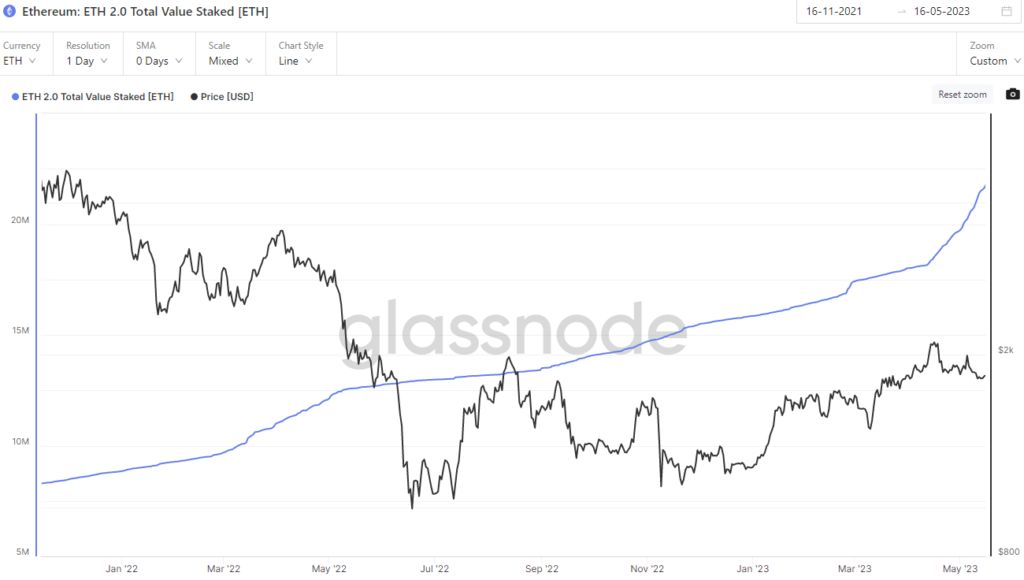
Ce nombre d’Ethers déposé en staking depuis la fin d’année 2020 est croissant mais depuis la mise à jour (mi-avril 2023), ce nombre a très fortement augmenté. Cela est une véritable réussite pour le réseau. Cette réussite peut mener à moyen/long terme à un nombre d’Ethers déposé en staking entre 50 et 70 %, comme nous pouvons le voir sur d’autres réseaux en PoS.
Voici ci-dessous, la nette augmentation des Ethers déposés en Staking surtout depuis la mise à jour de mi-avril 2023.
Valeur totale d’Ether en staking sur Ethereum Source : Glassnode
La tokenomics d’Ethereum a changé en 2022/23. Nous ne pensons pas que les acteurs du marché ont réellement intégré cette modification. Nous sommes très optimistes sur le jeton Ether pour les années à venir.
Les cycles de l’adoption du Bitcoin :
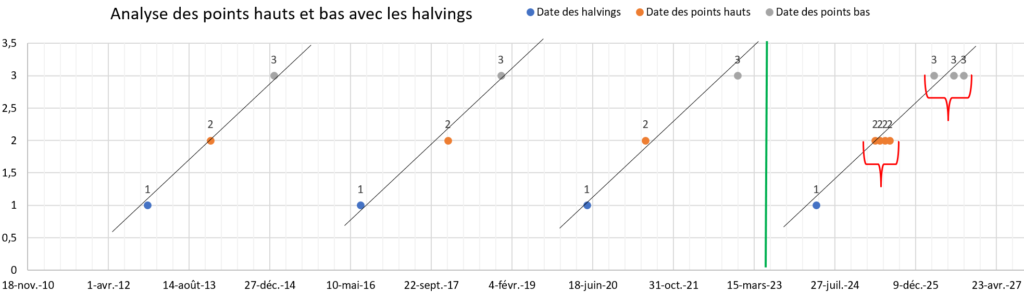
Lors de nos recherches, nous avons analysé la fréquence des cycles du Bitcoin. Nous avons isolé uniquement 3 points par cycle : le jour du Halving, le point bas d’un cycle et le point haut d’un cycle. Comme nous pouvons le voir sur le graphique ci-dessous, il y a une régularité de la fréquence de chacun de ces points qui est quasiment parfaite. Pour ce qui est des dates de Halving, c’est normal, mais ce qui est intéressant, c’est que les points bas et les points haut des cycles se sont parfaitement adaptés à la fréquence des Halving.
Les points bleus sont les dates des Halving, réglées sur une fréquence moyenne de 4 ans par le protocole Bitcoin.
Les points oranges sont les dates des points hauts du marché pour chacun des cycles.
Les points gris sont les dates des points bas du marché pour chacun des cycles.
Analyse temporelle des points hauts et des points bas des cycles de Bitcoin ainsi que des halvings Source : Interne
Il y a un point commun à noter, beaucoup le savent mais c’est important de le répéter : chacun des points oranges, donc des points hauts du marché, sont plus hauts cycles après cycles :
Décembre 2013 : $1 237
Décembre 2017 : $20 089
Mai 2021 : $68 789
Idem pour les points bleus, donc les points bas du marché, ils sont plus hauts cycles après cycles :
Décembre 2014 : $171
Décembre 2018 : $3 191
Novembre 2022 : $15 599
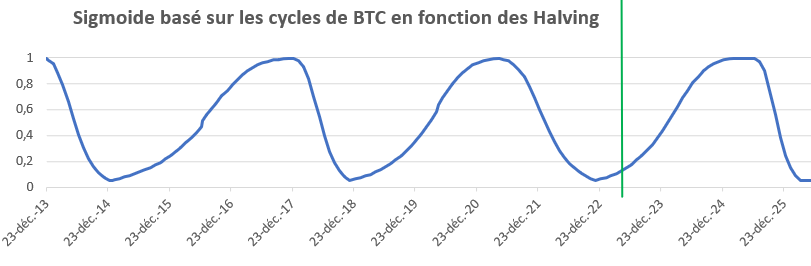
Nous pouvons apercevoir ces mêmes cycles de façon plus visuelle sur le graphique ci-dessous. Seuls les points hauts et bas des cycles sont représentés dans ce graphique par la droite horizontale de valeur 1 (points hauts) dans l’axe des ordonnées et par la droite horizontale de valeur 0 (points bas).
Sigmoïde basée sur les cycles du Bitcoin en fonction des Halving Source : Interne
Il est finalement assez facile de prédire la période pendant laquelle il y aura les points bas et hauts des cycles futurs. Evidemment, il est plus difficile de sortir ou d’entrer en position à ces moments-là car la psychologie dans laquelle se trouvent nos cerveaux humains bouleverse nos prises de décisions. C’est pour cette raison que nous essayons d’automatiser nos prises de décisions sur des éléments non-psychologiques et/ou non-sentimentaux.
Bilan de la Banque centrale des États-Unis et de la Banque centrale de la zone euro :
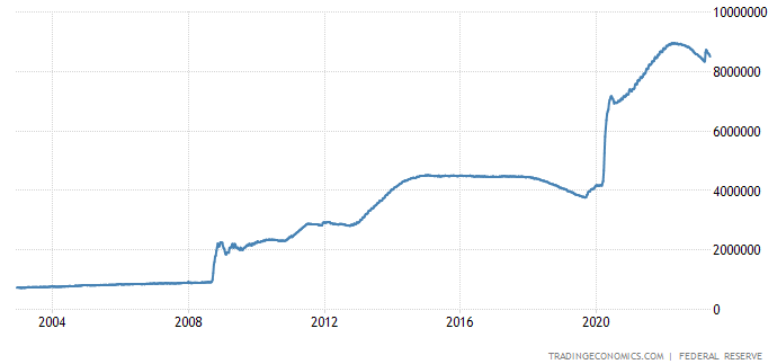
Nous pouvons voir sur le graphique ci-dessous, l’augmentation du bilan de la Banque centrale des États-Unis depuis les années 2004. Il est assez simple de comprendre pourquoi la valeur du Dollar, s’est dépréciée fortement lors de ces deux dernières décennies.
Bilan de la banque central des États-Unis 2004 – 2023 Source : tradingeconomics
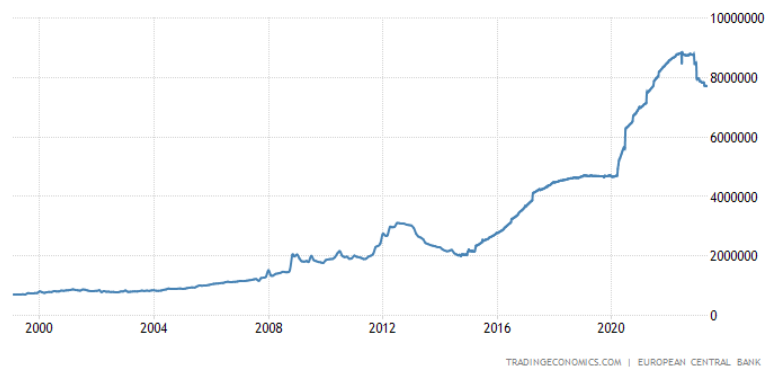
C’est le même constat pour le bilan de la Banque centrale de la zone euros :
Bilan de la banque centrale de la zone euro 2000 – 2023 Source : tradingeconomics
Les lecteurs pourront nous dire que l’inflation n’est que très récente, que nous n’en avons pas eu depuis très longtemps alors que nos banques centrales « impriment » depuis longtemps, pourquoi ?
Oui effectivement, mais la réponse est que la façon dont nous mesurons l’inflation est tout simplement erronée. Nous ne mesurons l’inflation que selon des critères très sélectifs qui ne représentent en rien la réalité.
Nous calculons le taux d’inflation dans nos économies de la même façon que cette métaphore :
« C’est un peu comme si nous tentions de mesurer la quantité d’eau qui tombe dans notre jardin quand il pleut avec un seau d’eau, et que nous multipliions la surface du seau d’eau jusqu’à atteindre la surface totale du jardin. Le calcul fonctionne mathématiquement et cela parait logique, mais cela ne fonctionne pas si vous vous placez sous votre préhaut avec votre seau pour essayer de capter l’eau de pluie. »
Effectivement l’inflation, telle que l’INSEE le calcule par exemple, n’a pas été très élevée ces deux dernières décennies. Par contre, tous les actifs, « non-imprimables à volonté » ont vu leur prix augmenter :
L’or, l’immobilier, les actions, les commodités etc… ont fortement augmenté. C’est dans ces actifs que toute l’impression monétaire, et donc « l’inflation », s’est stockée pendant des années. Cela provoque d’énormes écarts de richesse entre les plus riches qui possèdent des actifs qui « gonflent » et les plus pauvres qui restent « coincés » dans un état de pauvreté. L’inflation est injuste.
Notre service
Nous proposons un service de gestion sous mandat de portefeuilles spécialisés dans les actifs numériques. Nous réalisons un accompagnement humain complet dans cet univers en adaptant l’allocation de votre portefeuille à votre profil de risque et à votre situation.
Notre gestion clé-en-main vous permet de profiter de l’évolution de ce secteur sans vous soucier du choix des actifs numériques à mettre dans votre portefeuille, ni des recherches approfondies sur les jetons, ni de la volatilité, ni des arbitrages, etc… Vous avez seulement à lire vos rapports mensuels et à investir régulièrement avec un horizon long terme (4 ans et plus).
Nous ne faisons pas de trading algorithmique ou de trading journalier, nous investissons pour le long terme dans des projets que nous connaissons et que nous comprenons. Nous faisons des arbitrages mensuels dans les portefeuilles et étudions en profondeur les actifs (surtout leur tokenomics) que nous mettons en portefeuille.
Si vous avez des questions, des remarques ou si vous souhaitez en savoir plus sur notre service, n’hésitez pas à nous contacter sur cette adresse mail : tristan.g@crypto-assets-management.comou à prendre un RDV téléphonique avec nous via ce lien.
— Avertissement —
Ceci n’est pas un conseil en investissement, personne ne peut prédire l’avenir.
Vous êtes seul responsable de vos décisions d’investissement.
Nous ne sommes pas responsables des pertes suite à une décision prise sur la base des informations dans cette lettre.
Recevez nos lettres dans votre boîte mail
Nous ne divulgons pas vos informations personnelles
Voir notre Politique de vie privée pour plus d'informations.
 Écrit par Tristan Goutte