Lettre N°22 : Début d’un nouveau cycle, inflation durable ?
 Écrit par Tristan Goutte
Écrit par Tristan Goutte
Écrit par Tristan Goutte

Bonjour à tous,
L’objectif de cette lettre est de vous informer sur la situation actuelle du marché des crypto-actifs, mais aussi des actualités récentes dans ce domaine. Cette lettre n’est pas un conseil en investissement, mais seulement un partage de mon point de vue personnel.
Comment les retraits de staking sur Ethereum (ETH) fonctionneront-ils ? Les futures mises à jour Shanghai et Capella de la blockchain Ethereum permettront aux validateurs de retirer les ETH verrouillés dans la Beacon Chain ou les récompenses obtenues par le staking. Comment ces retraits vont-ils fonctionner ? Combien de temps faudra-t-il attendre ? Toutes les réponses sont dans cet article.
–
Coinbase est prête à défendre devant les tribunaux la légitimité de ses services de staking. Alors que les regards sont tournés vers la Securities and Exchange Commission (SEC) et son hostilité envers les services de staking, Coinbase maintient que ceux-ci ne sont pas des titres. En cas de besoin, la plateforme se dit prête à aller défendre ses convictions devant les tribunaux.
–
Paxos est en désaccord « catégorique » avec le choix de la SEC de classer le BUSD comme valeur mobilière. Bien que Paxos arrêtera bel et bien d’émettre le BUSD de Binance à partir du 21 février, la société s’est défendue dans un communiqué en affirmant que le BUSD ne pouvait pas être classé en tant que valeur mobilière. Par ailleurs, Paxos s’est dite prête à se lancer dans un éventuel litige avec la SEC dans le cas où l’organisme se montrerait fermé au dialogue.
–
Siemens émet sa première obligation numérique sur la blockchain Polygon (MATIC) Siemens, 3e entreprise allemande cotée en bourse par sa capitalisation boursière, a émis sa première obligation numérique d’une valeur de 60 millions d’euros sur la blockchain Polygon (MATIC). Grâce aux nombreux avantages que les obligations numériques procurent face aux obligations traditionnelles, la multinationale semble prête à réitérer l’expérience.
–
Le PDG de Mastercard imagine « un monde où tout sera tokenisé ». Mastercard, la seconde entreprise au monde dans le secteur des solutions de paiement, compte prendre de l’avance sur ses concurrents. Après des années à utiliser la blockchain, son dirigeant Michael Miebach affirme que « nous allons vers un monde où tout sera tokenisé ». On fait le point sur le positionnement de l’entreprise dans le Web3.
–
Le Lightning Network de Bitcoin ne connait pas le bear market. Le Lightning Network, solution de seconde couche de la blockchain Bitcoin, continue son expansion à travers le monde. Le réseau à la grande scalabilité vient de surpasser l’un de ses records : près de 5 400 bitcoins (BTC) sont aujourd’hui déposés dans cette solution, preuve d’un engouement continu pour la reine des cryptomonnaies.
–
La néobanque Revolut lance un service de staking pour l’ADA, le DOT, le XTZ et l’ETH. La néobanque Revolut fait un nouveau grand pas vers les cryptomonnaies. Elle serait en effet en train de lancer des services de staking, disponibles dès cette semaine pour les utilisateurs situés en Union européenne et au Royaume-Uni.
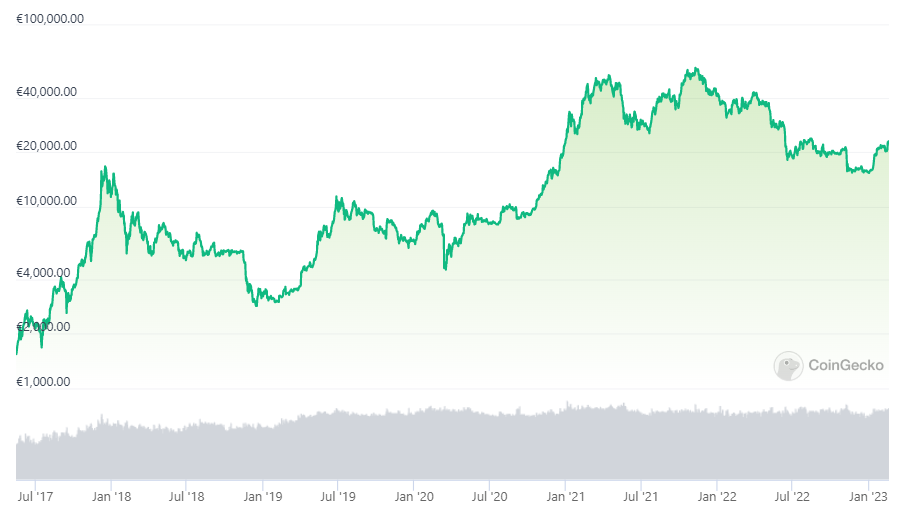
Le cours du Bitcoin à l’heure où j’écris ces lignes est de 24 600 $ (le 19/02/23).
Il est fort probable que nous ayons terminé ce marché baissier qui aura duré de novembre 2021 à novembre 2022. C’était le sixième cycle baissier depuis toute l’existence du Bitcoin et nous entamons le septième cycle haussier. Voici, ci-dessous, un graphique qui permet de mieux se représenter en image chacun de ces cycles. Il y a les grands cycles de 4 ans, et des petits cycles intermédiaires au sein de ces cycles.
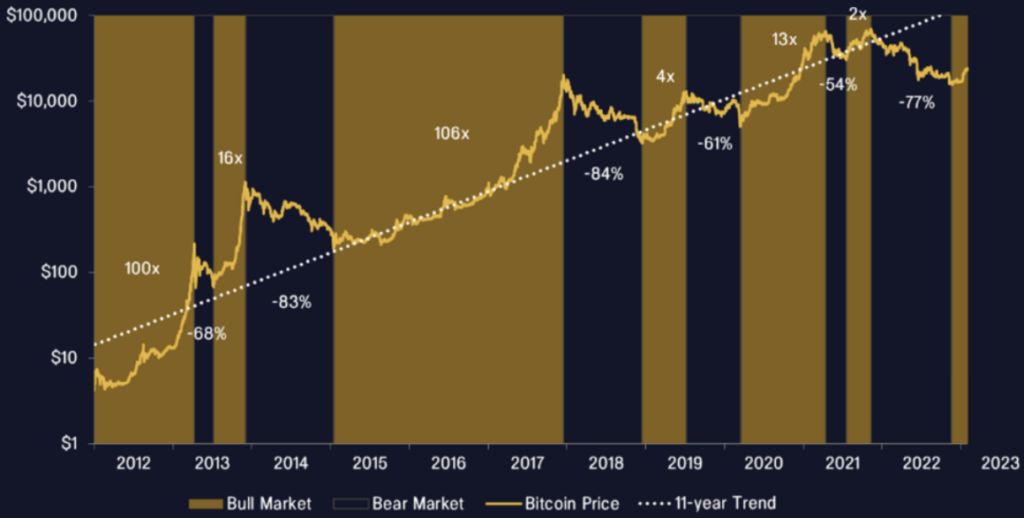
Nous pouvons voir ci-dessus, en orange, les cycles haussiers et en noir les cycles baissiers. Ce qui est impressionnant, c’est que la tendance haussière séculaire moyenne est de x 2.3 par an ! Tous les actifs ne peuvent pas se targuer d’avoir une croissance fondamentale si élevée. Cela dépend bien sûr de l’adoption et ce n’est pas infini.
L’adoption s’arrête quand nous sommes proches de 80 % voire de 100 %. Cela dépend de la pertinence et de l’utilisation des technologies, sachant que nous parlons cette fois-ci de la technologie de la Blockchain et pas seulement de Bitcoin. Aujourd’hui, l’adoption mondiale est estimée à 4 %.
Voici ci-dessous un graphique qui représente les taux et les vitesses d’adoption des technologies aux US ces 150 dernières années.
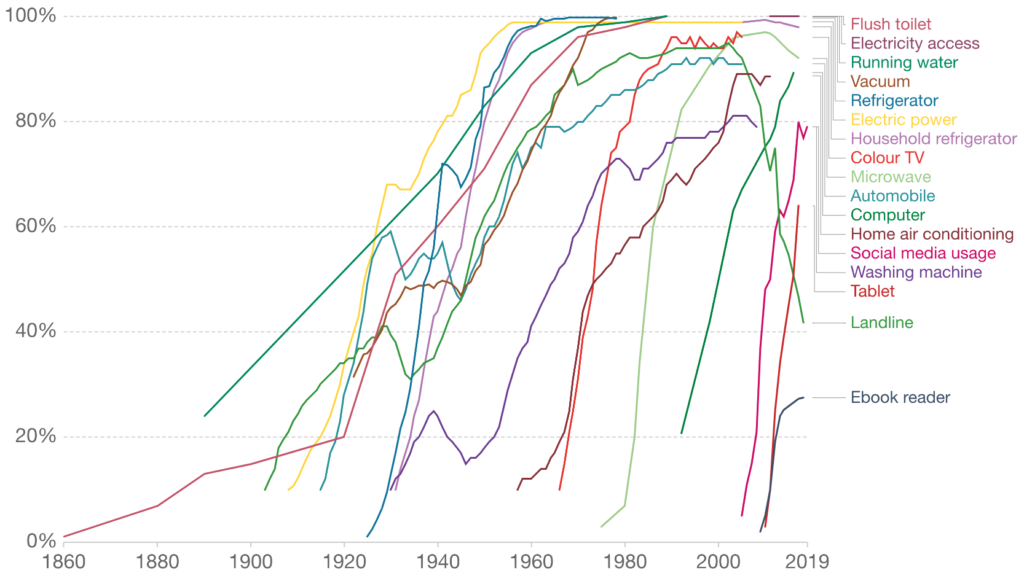
On remarque que plus on se rapproche des années récentes et plus les technologies sont adoptées rapidement. En effet, certaines utilisent des technologies précédemment adoptées. Par exemple, l’ordinateur utilise Internet et l’accès à l’électricité pour être adopté.
C’est lors de ce début d’année, suite à un réinvestissement des acteurs dans les actifs numériques, que le marché a compris que le cycle baissier était terminé. Les entités les plus grosses telles que les baleines et les institutionnels était les accumulateurs de ces derniers mois de marché baissier. Ces entités, qui ont accumulé près du creux, ont eu tendance à récupérer des profits juste après, et donc de distribuer leurs jetons début février. C’est sans doute pour cette raison qu’après avoir touché un plus haut local le 2 février à 24 300 $, nous avons eu un retracement jusqu’à 21 400$.
Sur le graphique ci-dessous, nous pouvons voir en jaune les périodes de distribution (sur une moyenne mobile de 7 jours) et en violet les périodes d’accumulation.
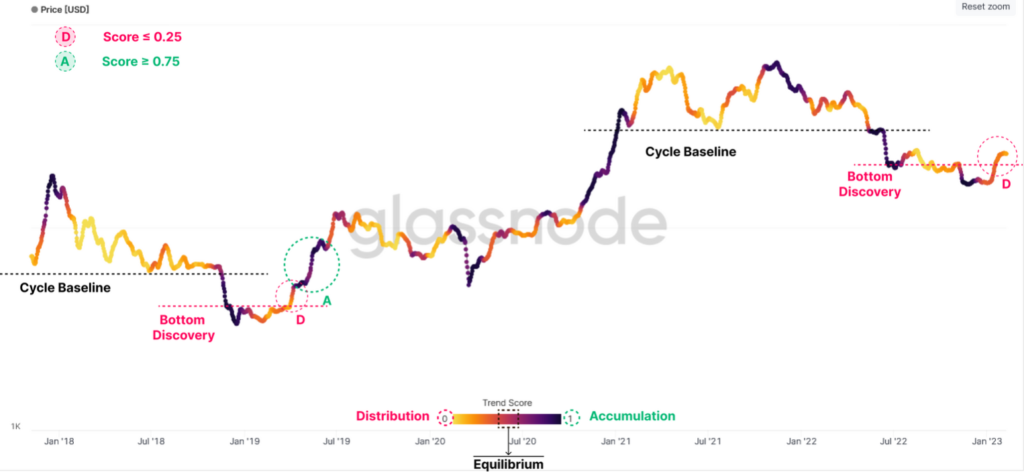
Comme lors de la fin du précédent grand cycle baissier en avril-juin 2019 (cercle rouge et vert ci-dessus), nous pouvons nous attendre à ce que les acheteurs reprennent la main en plusieurs temps avec des phases d’accumulations/distributions. L’étape suivante sera probablement une phase du même type que le cercle A (en vert) en avril-juin 2019. La phase d’accumulation a d’ailleurs déjà commencée puisque nous sommes déjà retournés vers les plus hauts de cette année 2023.
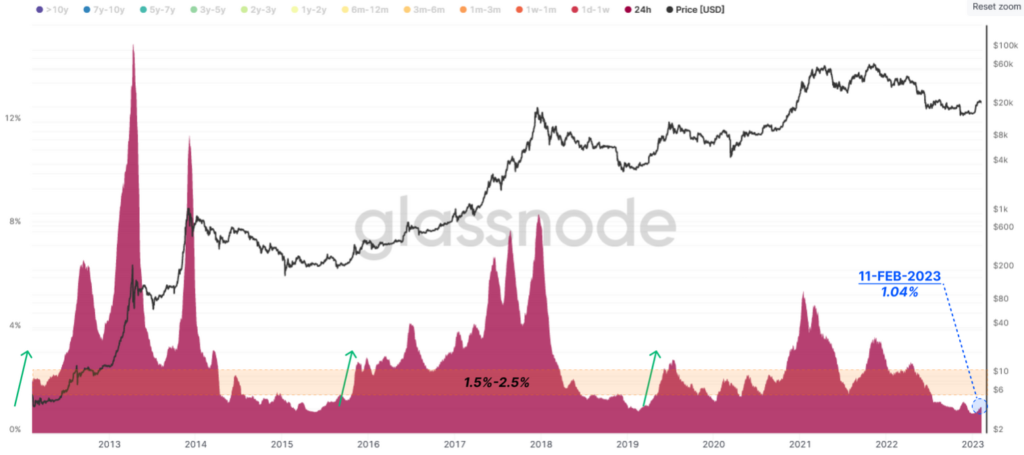
Nous pouvons remarquer ci-dessous sur le graphique qui représente la part relative de la richesse en dollars qui change de main quotidiennement, que nous sommes au début d’un potentiel afflux de liquidité qui devrait franchir la bande 1.5% – 2.5% en orange. Historiquement, cela a été le cas à chaque début de grand cycle haussier.
–
Pour ce qui est de la macroéconomie, il y a une baisse de l’inflation aux US et en Europe et le pic d’inflation aux US est probablement déjà passé. Toutefois, l’inflation sous-jacente s’est fortement installée dans nos économies et je pense que le marché sous-estime ce risque. Le marché pense que l’inflation va retourner vers ses plus bas en dessous de 2 % dans les deux années à venir. Je pense que cela ne se produira pas. L’inflation mettra beaucoup plus de temps à disparaître : il ne suffit pas d’avoir augmenté les taux pour que l’inflation chute immédiatement après.
De plus, la force de l’augmentation des taux d’intérêts réels (taux d’intérêt nominal moins l’inflation) n’est pas très élevée par rapport aux autres montées de taux historiques : à chaque fois, l’inflation n’a pas été vaincue facilement et rapidement. Je pense que l’inflation restera durablement au-dessus de 4 %.

Si vous avez des questions, des remarques ou si vous souhaitez en savoir plus sur notre service, n’hésitez pas à nous contacter : tristan.g@crypto-assets-management.com
— Avertissement —
Ceci n’est pas un conseil en investissement, personne ne peut prédire l’avenir.
Vous êtes seul responsable de vos décisions d’investissement.
Nous ne sommes pas responsables des pertes suite à une décision prise sur la base des informations
Nous ne divulgons pas vos informations personnelles Voir notre Politique de vie privée pour plus d'informations.