Lettre N°17 : Mise à jour d’Ethereum (The Merge), prix de l’énergie, récession.
 Écrit par Tristan Goutte
Écrit par Tristan Goutte
Écrit par Tristan Goutte
Bonjour à tous,
L’objectif de cette lettre est de vous informer sur la situation actuelle du marché des crypto-actifs, mais aussi des actualités récentes dans ce domaine. Cette lettre n’est pas un conseil en investissement, mais seulement un partage de mon point de vue personnel.
The Merge représente la migration de la blockchain Ethereum (ETH) vers une nouvelle méthode de consensus. Cette fusion est l’une des prouesses techniques les plus impressionnantes de l’industrie des crypto-actifs, et l’événement approche à grands pas. La fusion marque la fin de nombreuses années de recherche, d’ingénierie et de développement, et fera passer la blockchain Ethereum d’un mécanisme de consensus par la preuve de travail (PoW) à un mécanisme de consensus par la preuve de participation (PoS).
À bien des égards, cet événement pourrait être considéré comme l’équivalent du changement d’un moteur thermique à un moteur électrique d’un avion, durant son vol ! Cet avion de 200 milliards de dollars, qui transporte également des centaines de milliards de dollars d’infrastructure financière, tout en voyageant à pleine vitesse.
La fusion a été officiellement prévue pour ce soir. Découvrez la date et heure exacte de la mise à jour d’Ethereum ici : https://cryptoast.fr/the-merge-countdown-timer-date-heure-exact/
–
THE MERGE : pourquoi Ethereum devient le projet favori des banques ? Les manœuvres s’accélèrent à l’approche de The Merge. Le 7 septembre dernier, la SEBA Bank, qui est réglementée par les autorités suisses, a lancé le staking sur Ethereum pour ses clients institutionnels. À travers sa nouvelle offre, la SEBA Bank accroît l’adoption d’Ethereum par les investisseurs institutionnels, qui pourront « jouer un rôle clé dans la sécurisation de l’avenir du réseau, via une contrepartie de confiance, sécurisée et entièrement réglementée », selon Mathias Schütz, responsable de la technologie et des solutions de la banque.
–
La Banque de Russie envisage de légaliser les paiements transfrontaliers en cryptomonnaies. Dans le cadre d’une interview télévisée, la Banque de Russie, historiquement opposée aux cryptomonnaies, aurait finalement repensé son approche au point de se montrer favorable à l’utilisation de ce type d’actifs pour les paiements transfrontaliers. Le Vice-Ministre des Finances de la Russie Alexei Moiseev a déclaré qu’il était « désormais impossible de se passer des paiements en cryptomonnaies » vu le contexte géopolitique actuel. L’industrie crypto n’aurait jamais pu imaginer cette déclaration il y a à peine 2 ans, certains cas d’usages sont devenus intéressants pour les grandes institutions et pour les pays.
–
Bitcoin (BTC) : MicroStrategy souhaite lever 500 millions de dollars pour financer ses investissements. Au travers d’une vente d’actions, MicroStrategy espère réunir jusqu’à 500 millions de dollars pour investir une partie de ces fonds dans le Bitcoin (BTC). Au moment de l’établissement de son document, MicroStrategy était toujours en possession de 129 699 bitcoins. Le prix moyen d’acquisition de ces derniers est annoncé à 30 664 dollars l’unité. Les sociétés privées ou publiques continuent d’acquérir des Bitcoins sur le long terme, c’est le signe que malgré le marché baissier, les professionnels continuent d’être convaincus des fondamentaux et de l’adoption de cette industrie. Voici un site qui permet de visualiser la quantité de Bitcoin détenue par les différentes parties (entreprises privées, publiques, pays, ETF).
–
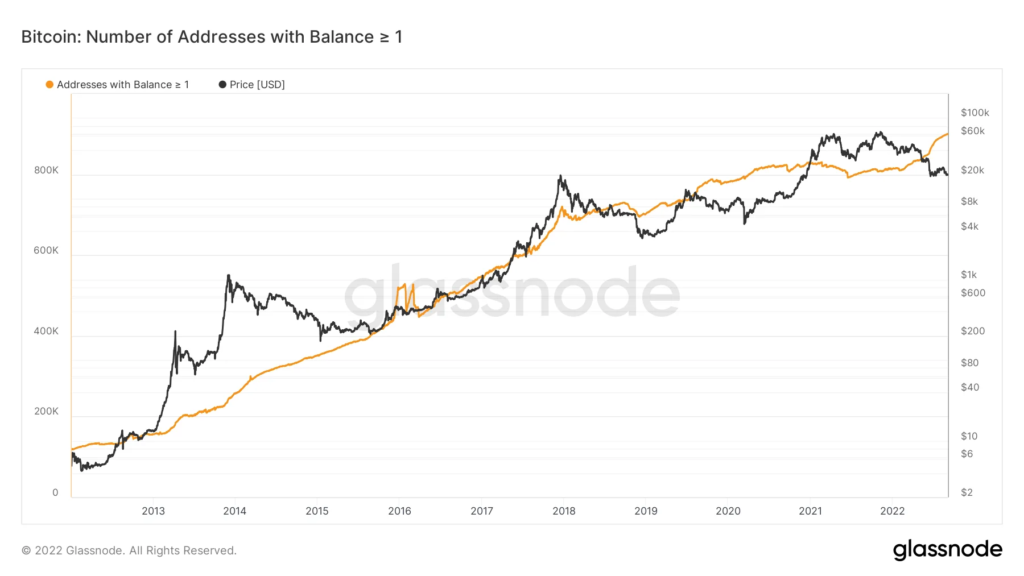
Bitcoin a-t-il une meilleure répartition des richesses que le système actuel ? Alors que le nombre d’adresses possédant plus d’un bitcoin (BTC) ne cesse d’augmenter, nous essayerons de déterminer si la répartition des bitcoins est plus équitable que la répartition des richesses dans le monde actuel. Ainsi, rapporté à ses utilisateurs, le pourcentage d’adresses avec au minimum 1 bitcoin est plus important que le pourcentage de millionnaires dans le monde avec respectivement 2,11% et 0,71%. Ces données sont à prendre avec des pincettes bien sûr, ce sont des approximations.
En revanche, on peut affirmer que le nombre d’adresses qui possèdent au moins 1 bitcoin (BTC) ne cesse d’augmenter. Il a même dépassé les 900 000 il y a quelques jours. Ci-dessous un graphique de Glassnode avec, en orange, le nombre d’adresses qui possèdent 1 bitcoin et en noir, le prix du bitcoin.
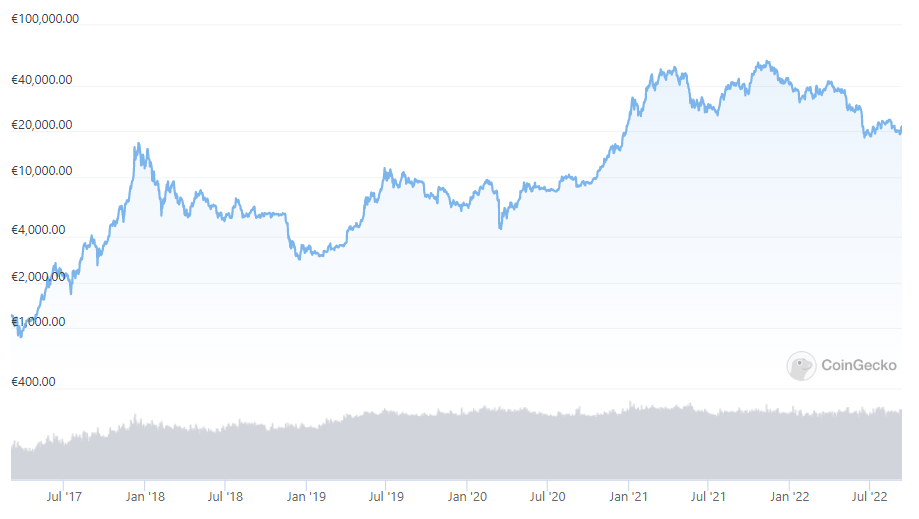
Le cours du Bitcoin à l’heure où j’écris ces lignes est de 22 100 $ (le 12/09/22)
Comme nous l’avions fait remarquer lors de la dernière lettre, la prudence était de mise pour la rentrée de septembre. Une phase de baisse a même commencé fin août, le marché a corrigé la phase haussière de l’été en allant toucher un plus bas autour de 18 300 $ en créant ainsi un double point bas autour de cette zone à presque 3 mois d’écart (juin et septembre). Depuis une semaine, le marché remonte lors de l’approche de la mise à jour d’Ethereum.
Personne ne peut annoncer avec certitude la fin du marché baissier, mais de nombreux indicateurs nous indiquent que nous sommes très proches de la fin de ce cycle de baisse (voir lettre N°15). Peut-être que la mise à jour (The Merge) du réseau Ethereum sera un catalyseur haussier pour mettre fin à ce cycle de baisse. Cela dépendra aussi des tendances macroéconomiques : il ne faut pas oublier que l’écosystème des crypto-actifs n’est encore qu’une goutte d’eau dans l’économie mondiale.
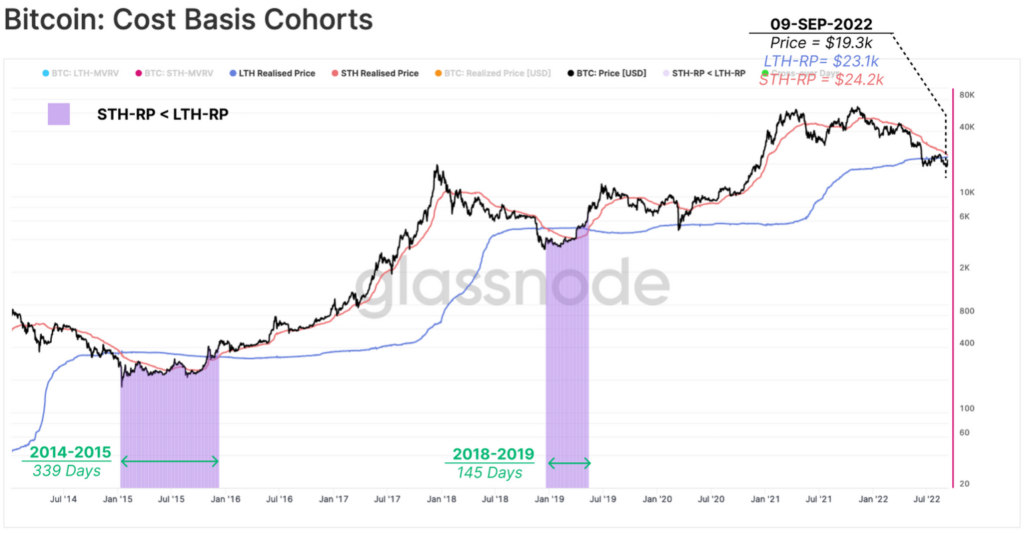
Il est probable que d’ici la fin de l’année, nous serons sortis de ce marché baissier au-dessus du prix réalisé (*) pour les détenteurs à long terme, voir la courbe bleue ci-dessous.
*Le prix réalisé est un indicateur en chaîne qui mesure le prix du BTC au moment de son dernier déplacement.
Nous pensons que dans les prochains mois, il y aura une décorrélation entre les marchés actions et les cryptos. Nous pensons cela pour plusieurs raisons :
Pour illustrer mes propos, prenons l’exemple de Tesla qui souhaite ouvrir une nouvelle usine dans un pays : alors la société créera de la dette pour la construire et développer son activité. Si cette dette lui coûte plus cher aujourd’hui (avec l’augmentation des taux directeurs) alors, elle renoncera au projet de sa nouvelle usine et cela réduira sa croissance.
L’industrie des crypto-actifs ne fonctionne pas comme ça : c’est principalement l’adoption, l’utilisation et la construction des cas d’usages qui crée la croissance à long terme des cryptos, pas la dette.
Cependant, à court terme, quand les taux directeurs montent, les actifs risqués baissent.
–
La BCE remonte ces taux directeurs de 0 à 0.75 % pour combattre l’inflation et la ramener à son objectif de 2% qui est le seul but de son mandat. Cette remontée des taux est insignifiante, pour vaincre l’inflation actuelle de la zone euro qui est à 9.1 %, il faudrait au minimum, avoir des taux aussi élevés que l’inflation, c’est-à-dire 9 %. Pour garder la stabilité économique en Europe et ne pas avoir de trop importants différentiels de taux entre les pays au sein de l’Europe, la BCE ne peut pas se permettre de remonter les taux si hauts. L’inflation sera probablement là pour du long terme et sensiblement au-dessus de 2 %.
–
Il faut savoir qu’en Europe, malgré l’absence d’annonces officielles, nous sommes déjà en récession (définition : période de recul temporaire de l’activité économique d’un pays). La question est de connaître l’intensité et la durée de cette récession ?
Avec les événements récents, notamment la coupure totale des arrivées de gaz depuis la Russie, nous pouvons être certains que cette récession ne sera pas légère. L’économie n’est que de l’énergie transformée. Si l’apport en énergie de l’Europe est coupé de 10 % alors l’économie européenne baissera de 10 %. De nombreuses sociétés en France et en Europe feront faillites ou fermeront leurs productions temporairement car le prix du gaz (et de l’électricité) est inélastique. S’il y a une disponibilité de 100 et que la demande est de 101, alors les prix explosent jusqu’à ce que le (1) en trop ne puissent plus payer son énergie (le plus faible économiquement) et que la demande soit à nouveau à 100.
Le blocage des prix de la part de nos politiques ne nous sauvera pas, il ne fait que repousser et amplifier le problème.
Quelques conseils pour les particuliers : ayez un rythme de vie adapté à votre patrimoine, soyez économe pour vous préparer à cette récession, consommer peu et intelligemment, prévoyez en avance vos sources d’énergie pour l’hiver si elles se stockent, préservez votre capital dans des actifs rares (or, immobilier, crypto…).
L’écosystème des crypto-actifs sera très peu impacté par cet événement, tout d’abord car c’est un marché mondial, mais aussi, parce qu’il nécessite peu d’électricité pour toutes les cryptos qui fonctionnent sur le Proof of Stake. Pour les cryptos qui fonctionnent sur du Proof of Work (notamment Bitcoin) leurs mining ne se fait pas en Europe, ni à la place des besoins humains en électricité. Le mining se développe principalement proche des zones d’excédent énergétiques. Il se développe aussi sur les stations de pétroles afin de remplacer les torchères ou vers les pays sous-développés qui regorgent d’énergie, mais qui n’ont pas d’infrastructures pour l’utiliser.
Si vous avez des questions, des remarques ou si vous souhaitez en savoir plus sur notre service, n’hésitez pas à nous contacter : crypto.assets.manage@gmail.com
— Avertissement —
Ceci n’est pas un conseil en investissement, personne ne peut prédire l’avenir.
Vous êtes seul responsable de vos décisions d’investissement.
Nous ne sommes pas responsables des pertes suite à une décision prise sur la base des informations de cette lettre.
Nous ne divulgons pas vos informations personnelles Voir notre Politique de vie privée pour plus d'informations.